Tax Season Is No Longer a Season: 2026 Marks the Era of Year-Round Compliance in India
For decades, Indian taxpayers lived by a familiar rhythm. The year would pass quietly, business would go on, income would be earned, and then suddenly, around July, panic would set in. Documents were scrambled, accountants were called at the last minute, deductions were guessed, and tax filing became a short but intense “season” of stress.
That era is officially over.
As we step into 2026, tax compliance 2026 in India has undergone a fundamental change in its nature. Tax is no longer something you “do once a year.” It is something you live with every month, every transaction, and every digital footprint you create. The government’s systems no longer wait for you to declare information. They already have it. Your responsibility now is not disclosure, but accuracy and alignment.
Welcome to the age of year-round compliance.
This shift is not just technical. It is psychological, operational, and strategic. And businesses and individuals who fail to understand this shift are the ones who will face notices, penalties, delayed refunds, and growing anxiety. Those who adapt early will experience something rare in taxation: peace of mind.
The Death of the “Once-a-Year Filing” Mindset
The idea of tax season was built on a simple assumption. The tax department knew only what you told them. That assumption no longer holds.
In 2026, tax authorities in India operate on real-time data collection. Your bank transactions, salary credits, GST filings, mutual fund investments, property purchases, TDS deductions, and even high-value expenses are continuously reported through interconnected systems.
The Annual Information Statement, AIS, and Form 26AS are no longer passive summaries. They are active monitoring tools. Every month, your financial behaviour feeds into a system that is constantly updated and cross-verified.
This means one critical thing:
If your records do not match the government’s records, the system will notify you immediately.
There is no “fix it later” window anymore.
What Changed and Why 2026 Is the Tipping Point
This transformation did not happen overnight. It has been building steadily over the last few years. But 2026 is the year when everything comes together.
Several developments have accelerated this shift:
• Advanced data analytics by the Income Tax Department
• Wider coverage of AIS and expanded reporting entities
• Automated GST matching and invoice reconciliation
• Real-time TDS and TCS reporting
• Integration between banks, registrars, GSTN, MCA, and tax systems
The result is a compliance ecosystem where delays, mismatches, and omissions stand out instantly.
Earlier, scrutiny was selective. Now, it is systemic.
Earlier, notices were manual. Now, they are automated.
Earlier, compliance gaps could be managed. Now, they compound.
Key Legal Provisions Driving Year-Round Compliance
- Section 139 – Mandatory return filing
- Section 143(1) – Automated processing and adjustments
- Section 234B & 234C – Interest on advance tax defaults
- GST Act Section 37 & 39 – Monthly/quarterly return filing
Why Year-Round Compliance Is Actually a Good Thing
At first glance, this may sound intimidating. Continuous monitoring can feel invasive or overwhelming. But when understood correctly, year-round compliance is a relief.
It replaces panic with predictability.
Instead of one stressful filing season, compliance becomes a routine habit. Before corrections were last-minute, but gradually you build accuracy. Instead of fearing notices, you prevent them altogether.
Businesses and individuals who embrace this shift experience:
• Fewer notices and mismatches
• Faster refunds
• Better cash flow planning
• Cleaner financial records
• Stronger credibility with banks and investors
Tax compliance stops being a reactive task and becomes a proactive system.
How Compliance Now Happens Every Month
To understand year-round compliance, it helps to see how tax obligations are now spread across the year.
Monthly responsibilities include
• Salary TDS deductions and deposits
• GST return filings and invoice matching
• PF and ESIC contributions
• Bank transaction reporting
• Expense tracking and categorization
Quarterly responsibilities include
• Advance tax payments
• TDS returns
• GST reconciliations
• Cash flow reviews
Annual responsibilities include
• Income tax return filing
• Audit reports where applicable
• Annual GST returns
• Financial statements
The key difference in 2026 is this:
Every monthly action directly impacts your annual tax outcome.
If one month is wrong, the entire year reflects it.
The Rise of “Always-On” Tax Data
One of the biggest reasons tax seasons is dead is the rise of always-on tax data.
Your financial life now leaves a digital trail everywhere:
• Banks report interest income
• Employers report salary and perks
• Mutual funds report redemptions
• Stockbrokers report capital gains
• GST portals report turnover
• Payment gateways report receipts
By the time you sit down to file your return, the tax department already has a near-complete picture of your income.
Filing is no longer about declaration.
It is about reconciliation.
That is why year-round tracking matters. If you track what the system tracks, filing becomes simple. If you ignore it, filing becomes a minefield.
Real Case Scenario
A salaried individual with freelance income fails to report ₹2 lakh consultancy income. AIS reflects TDS under Section 194J. During processing under Section 143(1), mismatch leads to tax demand plus interest under Section 234B.
How Businesses Are Adapting to Year-Round Compliance
Smart businesses have already stopped treating tax as an annual event.
Instead, they have built compliance into their operations.
They do three things consistently
1. They track data monthly
Instead of waiting for year-end, they reconcile GST, TDS, and income figures every month.
2. They use technology
Automation tools pull data from portals, match entries, flag discrepancies, and send alerts early.
3. They work with compliance partners
Rather than juggling filings themselves, they rely on experts who monitor deadlines, changes, and risks continuously.
This is where platforms like TaxuFiling become essential. Not just for filing, but for ongoing compliance health.
What This Means for Individuals and Professionals
This shift is not limited to businesses.
Salaried individuals, freelancers, consultants, creators, and investors are equally affected.
If you earn income from multiple sources, invest actively, or receive foreign income, your financial profile is already complex.
Year-round compliance helps individuals
• Track deductions properly
• Avoid underreporting income
• Claim refunds faster
• Prevent sudden tax liabilities
• Stay audit-ready
Instead of fearing tax season, individuals who stay compliant all year approach filing with confidence.
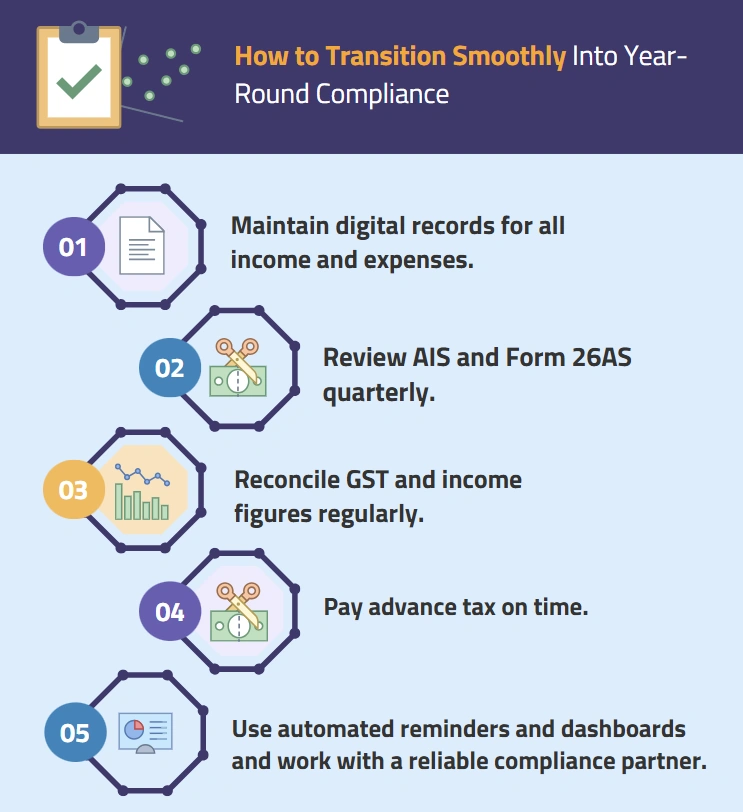
How to Transition Smoothly into Year-Round Compliance
The shift does not require complexity. It requires consistency.
Here is a practical approach:
When compliance becomes routine, it stops being stressful.
The Real Benefit: Mental Freedom
Perhaps the biggest advantage of year-round compliance is psychological.
No panic.
No last-minute scrambling.
No fear of unknown liabilities.
You know where you always stand.
Tax filing becomes a formality, not an ordeal.
That is the future of taxation in India.
FAQ
It means managing taxes continuously throughout the year instead of only during filing season to avoid errors, penalties, and notices.
Because the tax system is now automated and data-driven, mismatches are easily detected and last-minute corrections are limited.
Salaried individuals, freelancers, businesses, startups, GST registrants, professionals, and HUFs should all follow it.
Mismatches can lead to tax notices, delayed refunds, or additional tax demands if not corrected early.
Yes, most notices are system-generated due to data mismatches, but they are easy to resolve with proper records.
By filing returns on time, paying advance tax, reconciling data regularly, and maintaining accurate books.
Yes, if your tax liability crosses the specified limit, advance tax must be paid to avoid interest penalties.
Final Thoughts: The End of Tax Season Is a Good Thing
2026 marks a fundamental shift in how India approaches taxation. Tax season is no longer a season because compliance never sleeps. The system is continuous, digital, and interconnected.
This is not something to resist. It is something to adapt to.
Businesses and individuals who accept this reality and build systems around it will thrive. Those who cling to old habits will struggle with notices, penalties, and unnecessary stress.
The question is no longer “When should I file my taxes?”
The real question is “How compliant am I right now?”
With the right mindset, the right systems, and the right partner, such as TaxuFiling, year-round compliance is not a burden. It is clarity, control, and confidence.
And that is exactly what modern taxpayers need in 2026 and beyond.
Get reviewed by Tax Compliance Experts at TaxuFiling – Specialists in GST, Income Tax, TDS & Regulatory Compliance across India.