New Tax Regime 2026 for Businesses: Complete Compliance & Preparation Guide for Indians
What the New Tax Regime 2026 Means for Indian Businesses
The new tax regime 2026 for businesses in India will not be just another financial update. It represents a structural shift in compliance, reporting standards, digital accountability, and tax planning strategy. Every entrepreneur, MSME owner, startup founder, and corporate finance head must understand how these changes may impact deductions, accounting systems, payroll structures, GST alignment, and overall tax liability. Early preparation is no longer optional — it is a competitive advantage
If your business has been comfortably running under the current tax system, this is the perfect time to step back and ask a vital question. Is my business truly ready for the future of taxation in India?
For many businesses across India, especially growing startups and MSMEs in cities like Hyderabad, preparing early with structured compliance support from platforms such as TaxuFiling has become a practical way to stay ahead of upcoming tax changes.
Updated Business Tax Transition – Quick Summary
- Who is affected? All companies, startups, MSMEs, LLPs, and growing businesses in India.
- What may change? Deductions, exemptions, reporting formats, compliance timelines, and digital scrutiny.
- Biggest risks? Penalties, audit triggers, GST mismatches, payroll errors.
- When to prepare? Ideally 12–18 months before implementation.
- Immediate action step? Conduct a compliance readiness audit and upgrade accounting systems.
Long-Term Planning: The Foundation of a Smooth Transition
Tax transitions are not overnight changes. They involve deep shifts in how income is reported, how expenses are recorded, and how compliance is managed. Businesses that fail to plan early often find themselves dealing with penalties, compliance gaps, or even cash flow disruptions.
Here is what long-term planning should focus on
- Updating accounting systems to match the formats that will be mandated under the new tax regime.
- Training your finance team on the revised processes so they can adapt quickly.
- Conducting trial runs of financial reporting under the new framework to identify potential bottlenecks.
- Setting aside budgets for unexpected compliance costs and technology upgrades.
When you plan long-term, the transition becomes a structured journey rather than a last-minute scramble.
For example, a Hyderabad-based manufacturing MSME that restructured salary components and digitized GST reconciliation ahead of regulatory updates reduced compliance errors by 40% and saved over ₹4.5 lakhs annually in tax inefficiencies. Early planning creates measurable financial impact.
The New Compliance Timeline for Businesses
12–18 Months Before: Conduct compliance audit & system review
9–12 Months Before: Upgrade accounting & payroll systems
6 Months Before: Trial reporting under new structure
3 Months Before: Employee payroll restructuring & GST reconciliation check
Implementation Phase: Continuous monitoring & professional advisory support
Adapting Your Accounting Systems Before the Deadline
Your accounting system must evolve to comply with the reporting expectations under the Income Tax Act 1961 and the Goods and Services Tax Act. With increased digital scrutiny and real-time reconciliation, outdated spreadsheets or manual bookkeeping can increase audit risks and penalties under Section 143(1) adjustments. Businesses must adopt cloud-based, audit-ready systems aligned with CBDT reporting standards.
Imagine filing your GST, payroll, and TDS with just a few clicks, while ensuring the reports align with the new tax codes. That is where modern accounting systems can give your business a serious advantage.
When preparing your systems, consider
- Cloud-based accounting platforms with automatic tax rule updates
- Payroll software aligned with revised deduction structures
- Integrated GST reconciliation tools for monthly compliance
- Audit-ready financial reporting formats
- Real-time compliance dashboards for finance teams
Upgrading now will save you from chaos later.
Many Hyderabad-based businesses are already shifting to modern, cloud-based accounting setups with guidance from TaxuFiling, ensuring their GST, payroll, and statutory reporting systems are aligned with the upcoming 2026 requirements.
Aligning Bookkeeping, Payroll, and GST Filing with New Rules
The tax regime of 2026 is expected to simplify structures but increase accountability. Bookkeeping, payroll, and GST are three pillars where compliance errors often occur. Getting them aligned early is a must.
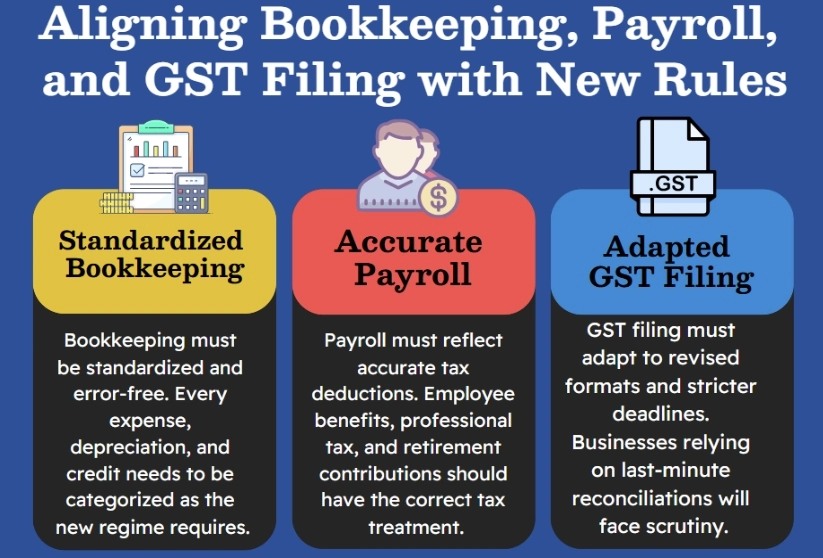
By synchronizing these three functions with the 2026 rules, you can ensure that every financial statement your business generates is accurate, timely, and compliant.
Strategic Tax Planning: Building a Smarter Business Structure
Tax planning is not just about saving money. It is about building resilience into your business model. With the new regime on the horizon, businesses have the chance to restructure operations in ways that maximize efficiency and minimize unnecessary liabilities.
Here are some strategies worth considering
- Deductions and exemptions: Analyse how traditional deductions will change under the new rules and plan alternative saving methods.
- Restructuring business entities: For some companies, shifting from a partnership to a private limited company, or vice versa, may optimize tax benefits.
- Investments and capital allocation: Redirect funds into areas that provide maximum tax efficiency under the new regime.
- International operations: If your business operates across borders, evaluate how double taxation treaties will interact with the new structure.
Smart tax planning today will ensure you are not just compliant in 2026 but also financially stronger.
Old Regime vs New Regime – Business Comparison
| Factor | Current Structure | Likely 2026 Structure |
| Deductions | Multiple exemptions | Limited or restructured deductions |
| Reporting | Periodic filings | Increased digital reporting |
| Audit Risk | Moderate | Higher data scrutiny |
| Compliance Load | Manual + digital | Fully system-driven |
The Role of Professionals: Why Expertise Matters More Than Ever
No matter how tech-savvy your business is, professional guidance during a tax transition is invaluable. Chartered accountants, tax consultants, and compliance advisors bring experience, foresight, and clarity that software alone cannot offer.
Professionals can help your business by
- Conducting readiness audits to identify compliance gaps.
- Interpreting grey areas of the new regime where practical application may differ from theory.
- Advising on restructuring moves that balance compliance with growth.
- Acting as intermediaries with government authorities if clarifications are required.
Think of them as navigators steering your business ship through uncharted waters. Their expertise can save you from costly mistakes and missed opportunities.
Technology as the Bridge to Compliance
One of the most exciting aspects of this transition is the growing role of technology in taxation. Artificial intelligence-powered compliance checkers, blockchain-enabled audit trails, and cloud-based filing systems are no longer futuristic ideas. They are becoming the norm.
Businesses that invest in these tools will be in a stronger position to adapt to the new regime. Automation reduces human error, enhances transparency, and provides real-time insights that decision makers can trust.
Employee Awareness: Training Your Team for Change
A tax transition affects not just your finance team but your entire organization. Employees must understand how the new regime impacts payroll, benefits, and deductions. Clear communication and training sessions can prevent confusion, build trust, and reduce errors.
When your employees know the “why” behind the changes, they are more likely to cooperate and contribute to compliance.
Building a Compliance Culture in Your Business
Compliance should not be treated as a year-end headache. It must become a culture embedded in daily operations. This means cultivating habits of accuracy, timeliness, and accountability across every department. When compliance becomes second nature, transitions like the 2026 tax regime become smoother and less stressful.
2026 Business Tax Preparation Checklist
- Conduct compliance readiness audit
- Review Section 115BAC applicability
- Upgrade accounting software
- Align GST and payroll reporting
- Evaluate business entity restructuring
- Reassess deductions & exemptions
- Train finance and HR teams
-
Schedule quarterly compliance reviews
FAQ
The 2026 tax regime is expected to simplify tax structures while increasing digital reporting, transparency, and accountability. Businesses may see changes in deductions, exemptions, reporting formats, and compliance timelines, requiring upgrades in accounting systems and tax planning strategies.
Preparation should begin at least 12–18 months in advance. Early planning allows businesses to upgrade systems, train teams, conduct trial reporting, and restructure finances without last-minute pressure or compliance risks.
While the new regime aims to reduce complexity, not all deductions may disappear. However, traditional exemptions could be limited or restructured, making strategic tax planning essential to maintain efficiency under the new framework.
Businesses will need accounting systems that support real-time reporting, automated compliance, integrated GST and payroll processing, and audit-ready formats. Manual bookkeeping or outdated software may increase the risk of errors and penalties.
While not legally mandatory, upgrading is highly recommended. Modern, cloud-based systems reduce human errors, adapt quickly to regulatory changes, and ensure smooth compliance with evolving tax requirements.
Changes in exemptions and tax structures may impact take-home salaries, benefits, and deductions. Businesses must update payroll systems and communicate clearly with employees to avoid confusion and dissatisfaction.
While certain structures may become default options, applicability depends on business type, turnover, and regulatory notifications issued by the Central Board of Direct Taxes. Businesses must evaluate eligibility before opting in or restructuring.
Changes to Section 115BAC may modify available deductions and alter tax rate structures. Companies must reassess salary structuring, expense booking, and investment planning to optimize tax efficiency under revised provisions.
Expert Insight from TaxuFiling Compliance Team
At TaxuFiling, we are already helping growing Indian businesses restructure their compliance systems to prepare for the 2026 tax transition. Businesses that act early typically reduce penalty exposure and improve cash flow efficiency during regime changes.
When Should You Consult a Tax Professional?
- If you receive a tax notice or scrutiny intimation
- If your business is considering restructuring
- If payroll deductions may change significantly
- If GST reconciliation mismatches are increasing
- If you are unsure how new provisions apply to your industry
The Final Word: Transition as an Opportunity, not a Burden
The new tax regime is not just a policy update. It represents a structural reset in how Indian businesses manage compliance, reporting, and long-term financial planning. Instead of viewing this as a burden, businesses should treat it as a strategic turning point.
For small businesses and startups, this transition offers a compliance advantage. By upgrading systems early and aligning financial processes, you reduce uncertainty and position your company as organized and investor ready.
For growing companies, adopting digital reporting tools and automation creates future-ready systems that minimize manual intervention and increase operational transparency.
Early preparation also ensures reduced penalty risk. Businesses that proactively update accounting software, reconcile GST properly, and restructure payroll avoid last-minute compliance errors and unnecessary notices.
Most importantly, strategic planning under the new framework leads to stronger financial control. When tax planning is aligned with business goals, companies gain clarity over cash flow, liabilities, and expansion decisions.
With structured preparation and guidance from trusted compliance partners like TaxuFiling, businesses can turn regulatory change into long-term growth. Preparation today builds resilience, credibility, and sustainable success for tomorrow.
Unsure how the new tax regime 2026 affects your business?
Get a Compliance Readiness Audit from TaxuFiling. Our experts will review your accounting systems, GST filings, and payroll structure to identify potential risks before the transition.