

Payroll & HR Compliance 2025: Indian Businesses Can Avoid Heavy Penalties, Notices & Audits
Payroll and HR compliance have always been part of running a business, but 2025 has raised the stakes higher than ever. The new rules around PF, ESI, TDS, and the Wage Code are reshaping how companies from large corporates to emerging startups handle employee compensation. What was once a back-office routine is now a boardroom concern, because a single mistake can lead to financial penalties, employee dissatisfaction, or even audits that eat into growth.
For businesses navigating this new era, compliance is not just about staying on the right side of the law; it is about building trust, avoiding reputational risk, and ensuring smooth operations. And the good news is, with the right approach, payroll and HR compliance can transform from a burden into a source of strength.
In 2025, payroll and HR compliance has become one of the biggest stress points for Indian businesses. With EPFO, ESIC, and Income Tax portals now fully digitised and interconnected, even a single PF or TDS mismatch can trigger instant notices. According to EPFO data, over 60% of payroll-related notices issued to MSMEs are due to delayed filings or incorrect wage calculations. What was once a back-office task is now a serious financial and legal risk.
Payroll Compliance in India 2025: New Rules, Portals & Real-Time Monitoring
2025 has been marked as a turning point for payroll compliance in India. Regulators have tightened timelines, upgraded reporting systems, and linked digital databases in ways that leave very little room for error.
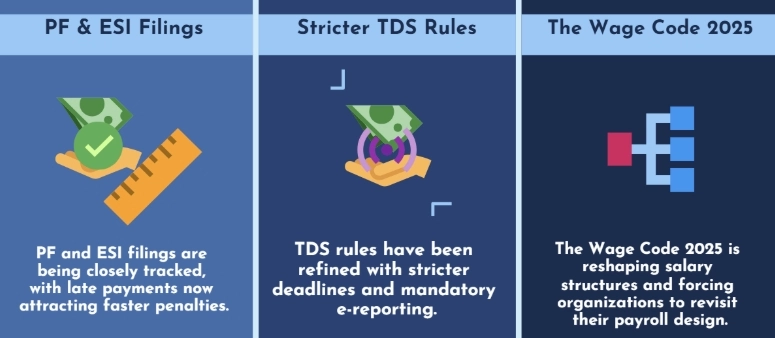
In short, compliance has shifted from being a once-a-month task to a real-time responsibility. Businesses that still rely on outdated spreadsheets or manual reconciliation are exposing themselves to unnecessary risks. This is why many companies are turning to reliable compliance partners like taxufiling.com, which simplify payroll filings and reduce the stress of last-minute errors.
Payroll Deadlines 2025: PF, ESI & TDS Due Dates You Cannot Miss
Missed deadlines have always been a nuisance, but under the new system, they are outright dangerous. Delays in depositing PF or TDS are not seen as operational slip-ups anymore; they are treated as compliance failures. Penalties accumulate quickly, and digital monitoring systems flag inconsistencies almost instantly. For instance, a small delay in TDS payment not only incurs interest but also reflects in mismatch reports, which can invite queries from authorities. Similarly, PF contributions that do not align with wage declarations raise immediate red flags.
The new environment demands deadline discipline. Companies must build payroll systems where dates are not negotiable; they are locked into the operational calendar. Think of it less as “compliance work” and more as “business continuity insurance.”
Wage Code 2025: Reshaping the Salary Puzzle
The wage code 2025 is perhaps the single biggest payroll reform of the decade. It changes how businesses define wages and calculate allowances. For employees, it promises more structured benefits and better financial protection. For employers, it means recalculating salary splits, rethinking take-home pay, and recalibrating budgets. Take a mid-sized IT company as an example. Before the wage code, allowances might form a large part of the salary to optimize tax impact. Under the new framework, allowances are capped, resulting in an increase in the “basic wage” portion, which directly impacts PF and gratuity outflows.
The Wage Code 2025 directly impacts how Indian businesses structure salaries. Key changes include:
- Basic wage must be at least 50% of total pay
- Allowances are capped, increasing PF & gratuity liability
- Higher statutory outflow for employers
- Lower take-home pay risk if restructuring is not handled carefully
for many companies, this means higher compliance costs unless payroll is restructured strategically.
This is not just a compliance adjustment. It is a financial restricting exercise. Companies that do not adapt risk payroll disputes, strained employee relations, and audit complications. Expert payroll restructuring through services like taxufiling.com can help businesses align with the new rules without hurting employee morale.
Payroll Mistakes in India: Penalties, Notices & Audit Risks Explained
One missed deadline or calculation error may not seem disastrous, but repeated mistakes create a domino effect. First comes the penalty, then the interest, and finally the erosion of employee trust when salaries or deductions do not add up. For startups and MSMEs, where every rupee and every reputation point matter, these errors can quietly derail growth.
Additionally, errors in payroll invite audits. Authorities now send computerized notices when there are digital mismatches, eliminating the need for yearly reviews. A minor discrepancy in TDS or PF can easily turn into an audit that takes up management’s time, resources, and attention.
Payroll compliance must therefore be handled by firms with the same rigor as tax returns or statutory audits. It is now a frontline business risk rather than “back-office paperwork.”
According to the Income Tax Department, over 1.3 lakh TDS-related notices were auto-issued in FY 2023–24 due to filing delays and mismatches. EPFO reports show that PF non-compliance penalties can go up to ₹1 lakh, along with interest at 12% per annum. These numbers highlight why payroll compliance in India can no longer be handled casually.
Smart Compliance: Technology as a Gamechanger
The old era of manual spreadsheets is officially over. Digital-first compliance is the only way forward. Advanced payroll systems can automate filings, generate error-free challans, reconcile deductions, and remind businesses of approaching deadlines. The real advantage is not just about saving time; it is about peace of mind. When payroll is automated, management can focus on strategy and growth rather than dreading consequences. Outsourcing to reliable partners like taxufiling.com guarantees compliance for companies lacking the bandwidth to develop these solutions themselves.
Preparing Your Compliance Playbook for 2025
So, how can businesses stay ahead of the compliance curve in 2025? It starts with a structured playbook:
1. Create a Calendar for Compliance
Set deadlines for PF, ESI, and TDS in your operational calendars and payroll systems. Think of these dates as essential to your business, not as optional.
2. Make Documentation Stronger
Clear trails—invoices, challans, and quickly retrievable digital records—must accompany each deduction, contribution, and payment.
3. Redesign Pay Scales
Adjust statutory contributions, perks, and take-home pay to comply with the Wage Code 2025. Managing expectations with employees requires open and honest communication.
4. Wherever possible, automate
Invest in payroll software that tracks compliance in real time and minimizes human mistakes.
5. Consult Experts Occasionally
To find weaknesses before regulators do, a compliance partner or certified public accountant can perform mini audits.
Compliance as a Competitive Edge
Payroll and HR compliance in 2025 is not just about avoiding penalties; it is about building a stronger, more resilient organization. Startups and corporates alike are realising that when compliance is seamless, it improves employee trust, investor confidence, and operational efficiency. Think of it this way: a business that consistently meets payroll deadlines and aligns with regulations projects stability. That stability attracts talent, wins client trust, and positions the company as a reliable partner. In an environment where growth is tough, compliance becomes a hidden competitive edge.
With the right systems, discipline, and expert partners, payroll compliance does not have to be overwhelming. Instead, it can become one of the most reliable pillars of your business strategy.
FAQ
1. What happens if PF or TDS payments are delayed in 2025?
Late payments attract interest and penalty faster than before, and mismatches in digital records may trigger compliance queries or formal notices from authorities.
2. How does Wage Code 2025 impact salary structures?
It increases the “basic wage” component, caps allowances, and directly affects statutory outflows like PF, gratuity, and leave encashment budgets, requiring companies to restructure payroll smartly.
3. Can startups still manage payroll manually using spreadsheets?
They can, but it’s risky. Manual payroll increases calculation errors, filing delays, reconciliation issues, and audit exposure, especially in the new connected digital compliance system.
4. What documents should businesses maintain to avoid audit trouble?
Companies must store date-wise challans, contribution receipts, PF/ESI/TDS payment proofs, wage declarations, Form 16/24Q/26Q filings, and digitally retrievable payroll trails.
5. Is outsourcing payroll a good option for small businesses?
Yes. If a company lacks internal bandwidth, outsourcing to a compliance partner reduces filing pressure, ensures accuracy, and protects against statutory failures.
6. Which areas of payroll compliance should be automated first in 2025?
Priority should be given to:
– statutory deduction calculations (PF, ESI, LWF, PT, TDS)
– challan generation
– filing reminders
– payroll–statutory reconciliation
– salary structuring checks
7. Is payroll compliance mandatory for small businesses and startups in India?
Yes. Even startups with a few employees must comply with PF, ESI, and TDS laws once applicable thresholds are crossed. Non-compliance can lead to penalties and portal-based notices.
Final Word: Compliance Is Not Optional; It is Survival
The era of “good enough” payroll practices is over. 2025 demands precision, transparency, and proactive compliance. Businesses that treat payroll as a side task risk falling behind, while those that embrace it as a core priority will thrive.
Payroll and HR compliance are ultimately about safeguarding your employees, your brand, and your growth trajectory, not just about checking boxes. Additionally, compliance is more than just survival when you have reliable partners like taxufiling.com on your side.
Struggling with payroll compliance in 2025? Don’t wait for notices or penalties.
Let TaxuFiling handle your payroll filings, PF, ESI, TDS, and Wage Code restructuring—accurately and on time. Speak to our compliance experts today and safeguard your business before mistakes turn costly.