
Struggling With Online Filings in 2025? Here’s Why DSC Is Mandatory for Indian Compliance
In the digital-first era, paperwork is fast disappearing, but security and authenticity matter more than ever. That is where Digital Signature Certificates (DSC) step in. For businesses, individuals, and even global entities interacting with Indian authorities, DSC is no longer just a technical tool; it is the official stamp of trust in the digital world. With 2025 bringing updated rules and tighter compliance, knowing when, where, and how to use DSC is non-negotiable. Whether you’re filing taxes, registering a company, or managing government portals, DSC has become the invisible backbone of your compliance journey.
Let’s break down what’s new, why it matters, and how you can secure your DSC with ease through trusted platforms like TaxuFiling.
Why DSC Matters More in 2025
Gone are the days when a physical signature carried all the weight. As the government shifts almost every compliance requirement online, DSCs act as your secure digital handshake, ensuring your filings, forms, and applications are both authentic and tamper-proof.
In 2025, updated rules now make DSCs:
- Mandatory for more filings than before.
- Central to e-verification of tax returns, MCA submissions, and GST compliance.
- A security safeguard against fraud and impersonation in sensitive transactions.
In short, if your business is serious about compliance, DSC is no longer optional; it’s your ticket to staying future ready.
DSC Usage in India: What the Numbers Say (2024–2025)
- Over 3.2 crore MCA forms were filed digitally in FY 2023–24, all requiring DSC authentication.
- More than 1.4 crore GST returns are filed monthly, with DSC mandatory for companies.
- As per Income Tax Department data, 100% of company ITRs are now DSC-verified.
- Government e-procurement portals report 70%+ tenders rejected due to signature or authorization errors.
Mandatory Uses of DSC in India
The scope of DSCs has expanded, and every business or individual should be aware of the key areas where they cannot proceed without one.
1. Income Tax Filings
- Companies and LLPs must file their ITRs using a DSC.
- Individuals earning above the specified thresholds or requiring an audit also need DSCs for verification.
2. MCA (Ministry of Corporate Affairs) Filings
- From incorporation to annual filings, every ROC submission demands a valid DSC.
- Directors and authorized signatories must sign eForms digitally.
3. GST Compliance
- GST returns, amendments, and refund applications for companies require DSC validation.
- Ensures that filings are genuine and not manipulated.
4. EPFO and ESIC Portals
- Employers managing PF and ESI contributions must authenticate with DSCs.
- Reduces fraudulent entries and ensures accurate employee records.
5. Tendering and e-Procurement
- Many government tenders require DSC-based bidding.
- Protects both government and businesses from fraud during bidding processes.
Pro Tip: Keep your DSC renewed well in advance to avoid last-minute compliance roadblocks.
New DSC Guidelines Every Business and Individual Must Know
2025 brings refined guidelines that tighten DSC issuance and usage. Here is what has changed:
- Stricter verification for issuance: PAN, Aadhaar, and updated KYC checks are mandatory.
- Shorter validity periods: While earlier DSCs could last up to three years, now stricter renewal cycles are being enforced.
- Foreign entities face new rules: They must submit notarized/apostilled documents for DSC issuance.
- Increased automation: Many portals now directly integrate DSC checks for e-signature, making manual uploads less common.
These changes are designed to increase transparency and security in every digital transaction.
How Foreign Entities and Individuals Can Get DSC in India
Doing business in India as a foreign company or individual? You can’t bypass DSC. It is just as mandatory. But the process is slightly different.
- Foreign individuals: Need to submit notarized passport copies, residence proof, and signed application forms.
- Foreign companies: Must provide apostilled incorporation documents, board resolutions, and details of authorized signatories.
- Verification: Video KYC or embassy verification is often required.
TaxuFiling has specialized support for foreign applicants, ensuring that documentation hurdles don’t delay business operations in India.
Step-by-Step Process to Apply for DSC with Taxufiling
Getting your DSC might sound technical, but the process is smooth if you follow the right steps. With TaxuFiling, the journey is streamlined and hassle-free.
1: Choose the Class of DSC
- Class 3 DSC: Mandatory for businesses, GST, MCA, ROC filings, and government tenders.
- Individual DSC: For personal ITR verification.
2: Submit Your Documents
- Aadhaar/PAN card
- Address proof (utility bill, passport, etc.)
- Passport-size photo
- For companies: Incorporation certificate, PAN, and board resolution
3: Complete KYC Verification
- OTP/e-KYC verification for individuals
- Video KYC for additional security
- Foreign applicants: Apostille/notarized verification
4: Download & Install DSC
- Once approved, you’ll receive a secure USB token.
- This device acts as your digital signature for all filings.
With TaxuFiling, the process is usually completed within 1–3 working days—fast, reliable, and stress-free.
How Businesses Can Avoid DSC Hassles in 2025
Handling DSC requirements manually can lead to mistakes, expired tokens, or rejected filings. Smart businesses are now automating their compliance processes with expert partners like TaxuFiling.
Here’s how:
- Renewal reminders: Never miss an expiry date again.
- Multi-user DSC management: Perfect for companies with multiple directors or signatories.
- One-click integration with GST, MCA, and Income Tax portals.
- Dedicated support for urgent filings and last-minute submissions.
This shift not only saves time but also prevents compliance penalties that can hit hard.
Why Choose Taxufiling for DSC Services?
Plenty of providers offer DSCs, but not all ensure smooth sailing. TaxuFiling goes beyond just issuing a certificate; it acts as your compliance partner in the following ways:
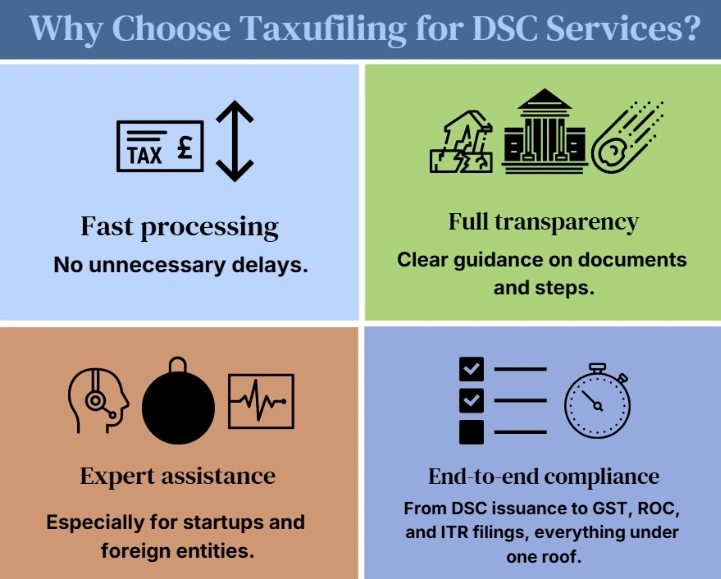
Think of it as not just getting a DSC but building a digital compliance ecosystem that keeps your business future ready.
FAQ
1. What is a Digital Signature Certificate (DSC)?
A Digital Signature Certificate (DSC) is a secure electronic signature issued by a licensed certifying authority. It verifies the identity of the signer and ensures that online documents, filings, and transactions are authentic, tamper-proof, and legally valid.
2. Is DSC mandatory in 2025?
Yes. In 2025, DSC is mandatory for company and LLP income tax filings, MCA and ROC submissions, GST filings for businesses, EPFO and ESIC compliance, and participation in government tenders and e-procurement portals.
3. Who needs a DSC in India?
DSCs are required by:
- Companies and LLPs
- Directors and authorized signatories
- Tax audit cases and high-income individuals
- GST-registered businesses
- Employers filing PF and ESI returns
- Foreign entities doing business in India
4. Which class of DSC is required in 2025?
Class 3 DSC is the most commonly required certificate in 2025. It is mandatory for MCA filings, GST compliance, income tax returns for companies, and government tenders. Individuals filing personal ITRs may require a standard individual DSC.
5. What is the validity of a DSC in 2025?
Authorities issue most DSCs with a validity of 1 or 2 years. Regulatory authorities are enforcing stricter renewal timelines in 2025, making it essential to track expiry dates and renew well in advance.
The Bottom Line: DSC is Your 2025 Compliance Passport
In 2025, a Digital Signature Certificate is no longer just a formality; it is the passport to legally operate and comply in India’s digital economy. Whether you’re a startup filing GST, a corporate submitting ROC forms, or a global player entering the Indian market, DSC is your entry point.
Handled correctly, DSC makes your compliance journey smooth, fast, and secure. Handled poorly, it can cause missed deadlines, penalties, and unnecessary stress.
This is why partnering with platforms like TaxuFiling is a smart choice. You don’t just get a DSC, you get peace of mind, timely compliance, and a team that ensures you never miss a beat in 2025 and beyond.
Don’t Let DSC Errors Delay Your Compliance in 2025
Whether you’re filing GST, bidding for tenders, or submitting MCA forms, a delayed or expired DSC can cost you money and peace of mind.