Fake GST ITC Claims Are Triggering Raids Across India: How MSMEs Can Avoid Notices, Blocked Credits & GST Audits
The GST system promised transparency, seamless credit flow, and a level playing field for businesses across India. But over the past few years, a shadow has crept in; fake Input Tax Credit (ITC) claims. Massive raids, blocked credits, penalties, and criminal investigations are now common headlines. What once seemed like a minor compliance issue can now spiral into a full-blown business nightmare. For MSMEs and startups, the stakes are high: one wrong invoice, one unchecked vendor, and your business could be under scrutiny.
So how can small and medium businesses survive this increasingly strict environment? How can startups sleep easily knowing they won’t be hit by surprise audits? Let’s break down the reality of fake ITC, how GST systems flag risky claims, and the practical steps every business must take to stay compliant.
Fraud Headlines That Wake You Up
Fake ITC fraud is not an abstract concept; it is happening every day. Enforcement agencies are uncovering networks of shell companies, bogus invoices, and circular trading schemes worth hundreds of crores. And it’s not just the big corporates; even small players have found themselves caught in these raids.
Imagine a start-up claiming ITC on raw materials, only to find out the supplier’s GSTIN is inactive, or the invoices dint match their filing. Suddenly, what seemed like an ordinary transaction becomes a red flag. Fraudsters exploit these gaps, but honest businesses can fall prey too, especially if reconciliation and vendor verification are ignored.
To avoid high-risk or non-compliant suppliers, you can get professional vendor verification and compliance review through the GST compliance support service. The lesson is clear: in today’s GST ecosystem, vigilance is non-negotiable.
Fake ITC: What It Really Means
Fake ITC can come in many forms, and not all of them are immediately obvious.
- Fake invoices are invoices for goods or services that were never delivered. Fraudsters use them to inflate turnover and claim undue tax credits.
- Mismatched returns are when the ITC you claim doesn’t align with your vendors’ GSTR filings, the GST system flags it. Even unintentional mismatches can result in blocked credits or penalties.
- Shell companies are what happens when some suppliers only exist on paper. No employees, no premises, no production, just invoices to pass credits. Buying from these companies can put your business directly in the audit crosshairs.
- Circular trading, in some cases, companies issue invoices to each other in a loop, creating the illusion of trade and multiplying ITC claims.
- ITC is often used to claim refunds, particularly in export transactions. If the base ITC is fake, any refund automatically becomes illegal.
For MSMEs, even dealing with a negligent vendor or failing to reconcile monthly can have serious consequences. Fake ITC doesn’t just happen to large players; it can affect any business that isn’t careful.
How GST Systems Catch Suspicious Claims
Today, the GST network is not just a portal; it is a watchful guardian:
- Mismatch monitoring: ITC claims are automatically checked against GSTR-2B. Discrepancies trigger alerts.
- Unusual spikes: Sudden ITC jumps compared to previous months attract scrutiny.
- Vendor profiling: GSTN monitors filing history, GSTIN status, and suspicious activity.
- Cross verification: other government data, like bank statements and utility bills, are checked against turnover.
- Blocking ITC: suspicious credits can be blocked immediately or assets attached before audits.
The takeaway? The system is proactive. Waiting until an audit notice arrives is too late. Compliance has to be proactive and continuous.
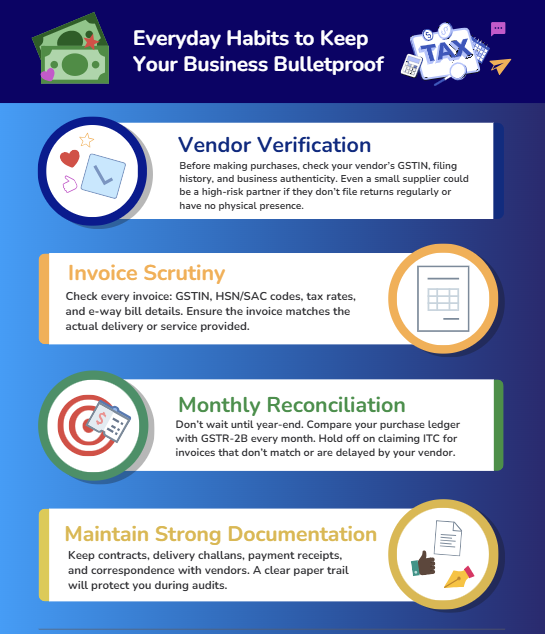
Everyday Habits to Keep Your Business Bulletproof
Avoiding trouble is not about luck; it is about implementing daily practices that safeguard your ITC claims.
- Vendor verification: before making purchases, check your vendor’s GSTIN, filing history, and business authenticity. Even a small supplier could be a high-risk partner if they don’t file returns regularly or have no physical presence.
- Invoice scrutiny: check every invoice: GSTIN, HSN/SAC codes, tax rates, and e-way bill details. Ensure the invoice matches the actual delivery or service provided.
- Monthly reconciliation: don’t wait until year-end. Compare your purchase ledger with GSTR-2B every month. Hold off on claiming ITC for invoices that don’t match or are delayed by your vendor.
- Maintain strong documentation: keep contracts, delivery challans, payment receipts, and correspondence with vendors. A clear paper trail will protect you during audits. With clean books, organized ledgers, and documentation ready for audits, this bookkeeping and accounting service can maintain everything month-to-month.
- Adopt technology: accounting software with automated GST reconciliation features can detect mismatches, flag high-risk vendors, and track ITC flow accurately. And for secure GST filings, e-way bill signing, and notice replies, you can easily obtain a legally valid Digital Signature Certificate (DSC).
Audit-Ready Always: The MSME Survival Playbook
MSMEs often fear audits the most, but preparation can turn audits into a manageable routine instead of a crisis.
Preparing for surprise audits doesn’t have to be a nightmare. Done right, it can actually give your business confidence and control. Start by keeping your books impeccably organized with invoices, challans, contracts, and bank statements digitized and easy to access, so you are never scrambling for proof. Every purchase should leave a clear trail, whether it is a bank transfer, UPI payment, or cheque, while cash transactions remain minimal and fully documented. Communication with vendors matters. Keep written records of confirmations, corrections, or late filings to show that your compliance is proactive and transparent. Finally, keep an eye on risk indicators by watching for sudden spikes in ITC, unusual dependence on specific vendors, or mismatches between inputs and production.
Master these habits, and surprise audits become less of a stress test and more of a confidence check for your business.
FAQ
1. What exactly counts as “fake ITC” under GST?
Fake ITC includes credits claimed on invoices where goods/services were never supplied, mismatched returns, purchases from shell companies, or credits claimed without valid documentation. Even unintentional mismatches can trigger scrutiny.
2. How can MSMEs avoid buying from fake or risky vendors?
Always verify the vendor’s GSTIN, filing history, and business existence. If this feels overwhelming, you can use GST compliance support services that professionally review vendors and flag high-risk suppliers before you transact.
3. What should I do if my GSTR-2B doesn’t match what my vendor has filed?
Hold the ITC until the vendor corrects their filing. Claiming mismatched ITC can lead to blocked credits or penalties. Monthly reconciliation services help businesses stay accurate and avoid these risks.
4. How do small businesses prepare for GST audits?
Digitize invoices, maintain contracts, track payments, and keep a clean audit trail. Legal consultation services and bookkeeping support can help you stay audit-ready throughout the year, not just at the last moment.
5. Are Digital Signature Certificates necessary for ITC-related filings?
Yes — companies, LLPs, and many professionals need a valid DSC to file returns, reply to notices, or upload audit documents. You can quickly get a valid DSC through the official service page.
6. Can a business accidentally claim fake ITC?
Yes. Even if you are honest, a negligent vendor, an inactive GSTIN, or mismatched invoices can make your ITC “fake” in the eyes of GSTN. That’s why vendor verification, monthly matching, and strong documentation are essential.
7. What’s the strongest long-term protection for MSMEs against fake ITC issues?
A combination of:
- verified vendors
- monthly reconciliations
- clean documentation
- audit-readiness
- professional bookkeeping
- strategic compliance planning
All of these reduce risks and protect your business from GST notices or audits.
Final Thoughts: Turn Compliance into Confidence
Surviving fake ITC scrutiny is not just about avoiding penalties; it is about building trust. Clients, partners, and even banks value businesses that maintain clean, transparent books. For MSMEs and startups, compliance becomes a differentiator: it signals reliability, professionalism, and operational maturity.
Shortcuts in tax may seem tempting, but the long-term risks far outweigh any temporary benefit. By verifying vendors, reconciling monthly, maintaining airtight documentation, and adopting smart technology, businesses can not only survive audits but also thrive in a regulated environment.
In the end, compliance is not a burden; it is your shield. It is what keeps your businesses safe, credible, and positioned for growth. For startups and MSMEs, staying vigilant today ensures they sleep easier tomorrow.
Consider this a wake-up call: go over your list of vendors, audit your most recent returns, mark anything that seems “too good to be true,” and create a procedure that is so robust that even unexpected audits become regular. Because justifiable diligence is sometimes the greatest defense in tax compliance, just like in life.