

Stay Ahead of the Curve: TDS and TCS Rules Every Business Must Master in 2025
The Indian tax system is going through yet another wave of transformation in 2025. If you are a salaried employee, a freelancer building your empire, or a corporate juggling payrolls and vendor payments, but one thing is certain: TDS (Tax Deducted at Source) and TCS (Tax Collected at Source) compliance is no longer optional; it is survival.
From new tax rule updates to stricter penalties and reporting requirements, the pressure to get it right has never been greater. But here is the twist: compliance does not have to be a headache. With the right understanding and systems in place< you can make TDS and TCS less of a monster and more of a powerful tool to keep your business clean, credible, and future-proof.
Let us break it all down, step by step, but in plain English.
What’s Changing? TDS and TCS in the New Era
The government is tightening the ropes in 2025 with sharper rules around how TDS and TCS are deducted, reported, and deposited. Some of the expected highlights include:
Revised TDS/TCS rates
Minor rate adjustments on professional services, e-commerce transactions, and high-value goods. For instance, freelance payments are under greater scrutiny as digital gig work rises.
Stricter Reporting Norms
Every deduction now needs to be tracked with precision, linked with PAN/Adhaar, and reconciled with the recipient’s return. No more “rough estimates”. Mismatches mean instant red flags.
Focus on High-Value Transactions
Luxury purchases, real estate, and large vendor bills are now under the microscope, making TCS more critical than ever.
Technology-Driven Monitoring
With AI integrated into income tax systems, delays and mismatches in TDS/TDS filings can trigger automated notices faster than ever before. If your business wants error-free TDS/TCS filings without risking AI-triggered notices, this Tax Support service helps automate deductions, filings and compliance.
The underlying message? Expect zero tolerance for errors.
Who Bears the Responsibility? Spoiler: Almost Everyone
The new rules are not just for corporations. TDS/TCS compliance spreads across the entire spectrum of income earners:
Salaried Employees
The new employer deducts TDS from your salary before it even hits your account. New rules mean tighter reconciliation of Form 16 with your ITR. If there is a mismatch, you will be the one chasing HR on the payroll team.
Freelancers and Consultants
If you are billing clients for services, expect TDS to be cut at source. The pain point? Clients may deduct TDS but delay depositing it, leaving you hanging until reconciliation. Under the new regime, both parties will face tighter scrutiny. Freelancers struggling with client-side TDS delays can simplify compliance through Bookkeeping and Accounting support.
Corporations and Startups
You are not just responsible for deducting TDS on salaries. Payments to vendors, contractors, landlords, and professionals all fall into your compliance net. For startups, this can feel overwhelming. One missed deduction can snowball into penalties and interest. Startups can avoid these mistakes by using simplified HR & Payroll automation services for accurate salary-TDS deduction. Utilising simplified HR & Payroll automation services for accurate salary and TDS deductions
The takeaway? Whether you are earning, paying, or both, TDS/TCS will touch you.
Penalties: Why Ignoring Deadlines is a Costly Affair
Here is the harsh truth: non-compliance is not just a mistake anymore; it is expensive.
- Late deduction or non-deduction: interest charges of 1% per month until deducted.
- Late payment of deducted TDS/TCS: interest of 1.5% per month until deposited.
- Failure to file returns: penalty of Rs 200 per day under section 234E, up to the actual TDS amount.
- Severe defaults: prosecution in extreme cases where defaults are deliberate.
Think of it like this: every day you delay, you are not just paying taxes, you are paying extra rent to the government for being late.
B2B and B2C Impact: Why These Rules Matter Beyond Compliance
TDS and TCS are not just about following laws; they impact business relationships and credibility. For B2B deals, a vendor deducts and deposits TDS accurately earns long-term trust. Vendors with compliance lapses often lose contracts because no one wants the headache of mismatched credits. For B2C businesses, higher TCS on luxury goods means pricing strategy matters. A jeweller, for example, must communicate these costs transparently to avoid customer distrust.
In short: compliance = trust = growth.
Automation: The Secret Weapon for Stress-Free Compliance
Let us face it, manual TDS/TCS management is a minefield. With multiple rates, deadlines, and certificates, even seasoned accountants slip up. The solution? Automation.
- Payroll software creates Form 16, computes TDS on salaries automatically, and communicates with accounting.
- Real-time TDS deduction on rent payments and vendor invoices is made possible by integrated accounting tools.
- Cloud dashboards: Display on a single screen who has been paid, who is pending, and when deadlines are approaching.
- AI-Powered Alerts: Make sure you never miss a filing again by reminding you ahead of time.
For MSMEs and startups, automation is not just a cost saver; it is a stress reliver. One subscription can save lakhs in penalties.
Compliance Checklist: Keep This Handy
If you forget everything else, remember this quick checklist:
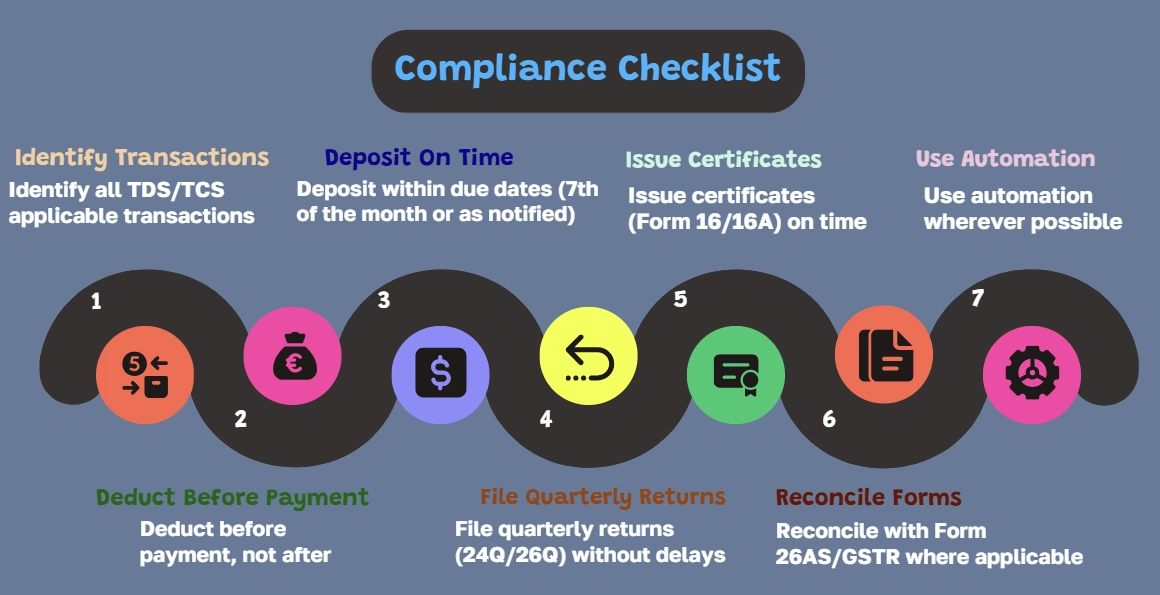
Stick to this, and audits become just another routine, not a nightmare.
CASE STUDY: How a Startup Dodged a Rs 5 lakh Penalty
Consider the instance of a SaaS startup situated in Bengaluru. A single accountant’s error caused them to miss TDS files for three consecutive months in 2023. Penalties had risen to ₹5 lakh by the time they realized. They incorporated an automated TDS module into its vendor payment and payroll system in 2024. All deductions were automatically tracked, reconciled, and reported. Outcome? Increased investor confidence, zero penalties, and zero defaults.
A lesson? What human memory cannot accomplish, technology can.
FAQ
1. What is the new TDS/TCS rules coming in 2025?
The 2025 rules introduce stricter reporting, AI-based scrutiny, quicker notices for mismatches, and updated rates for professional services, e-commerce, and high-value transactions.
2. Who must comply with TDS and TCS rules?
Businesses, freelancers, salaried individuals, startups, corporations, landlords, e-commerce sellers — anyone who pays or receives taxable income.
3. What happens if TDS is deducted but not deposited?
Both the diductor and the recipient face issues: interest at 1.5% per month, delayed credit in Form 26AS, and possible automated notices.
4. How can startups automate TDS/TCS and avoid mistakes?
Using HR Payroll systems, bookkeeping software, and automated tax-deduction platforms.
5. How does TDS affect freelancers?
Clients deduct TDS on freelancer invoices. If they delay depositing, reconciliation becomes difficult.
6. How can businesses avoid TDS/TCS penalties?
By timely deduction, correct rate selection, on-time deposit, automated systems, and periodic reconciliation.
7. Do luxury purchases attract TCS in 2025?
Yes. High-value jewelry, vehicles, and certain luxury goods attract TCS at revised rates.
Final Word: TDS/TCS as Your Business Badge of Trust
Here is the truth: TDS and TCS are not designed to punish businesses; they are designed to keep the economy transparent. While the rules can feel intimidating, mastering them boosts your reputation.
Think of every compliance step as polishing your brand’s credibility. Employees get smoother Form 16s, vendors get accurate credits, customers see transparent pricing, and you? You earn the one currency more valuable than money in business: trust.
Therefore, don’t wait for fines to wake you awake as the new tax laws take effect. Become proactive, automate the process, and use TDS/TCS compliance to your advantage. Ultimately, the most successful companies in 2025 will not only be the most lucrative but also the most compliant.