Income Tax Act, 2025: What Every Indian Must Know Before It Comes into Force
The Indian tax system is on the verge of a major shake-up. The government is replacing the outdated Income Tax Act of 1961 with the brand-new Income Tax Act, 2025. This isn’t just a minor update; it’s a complete transformation aimed at simplifying tax compliance, increasing transparency, and digitizing the entire process for individuals and businesses alike. Whether you are a salaried professional, a business owner, or managing a Hindu Undivided Family (HUF), ignoring this change could cost you. To understand how these upcoming reforms will affect your yearly tax return, and for individuals and businesses preparing early for the Income Tax Act, 2025, you can explore expert tax guidance and compliance support. What’s happening, why it matters, and how to advance before the new law takes effect are all laid out in this straightforward summary.
Why the 1961 Act Is Being Replaced?
For over six decades, the Income Tax ACT, 1961, has been the foundation of India’s tax framework. But the system has gradually become a complex web of outdated provisions, confusing exemptions, and manual processes.
Key reasons for the overhaul:
- Inefficiency: Manual filings, several formats, and time-consuming paperwork have long been problems for businesses and taxpayers.
- Lack of uniformity: Distinct formats and interpretations have led to needless obstacles in compliance.
- Digital Evolution: With the removal of the previous law, the economy has undergone a significant transition toward automated procedures, digital payments, and real-time data reporting.
- Global Standards: To encourage investment and facilitate business transactions, India’s tax regulations must be in line with global best practices.
The Income Tax Act, 2025, promises a simpler, more transparent tax system designed for the digital era.
Key Changes You Can’t Afford to Ignore
For Salaried Individuals
Many exemptions, like HRA, medical reimbursements, and transportation allowance, are eliminated under the new tax system, which also provides unified tax slabs. Anticipate real-time tax credit changes and quicker refund processing.
Applicable to Businesses
Everything will be automated and done online, including filing tax returns, TDS reports, and audit submissions. Audits will be simpler and take less time if all industries use the same accounting standards.
For Hindu Undivided Families (HUFs)
New rules will impose stricter guidelines on income splitting and taxation to prevent misuse, and digital reporting of HUF accounts will ensure full transparency and easier filing.
The Big Shift: Current Regime vs New Law
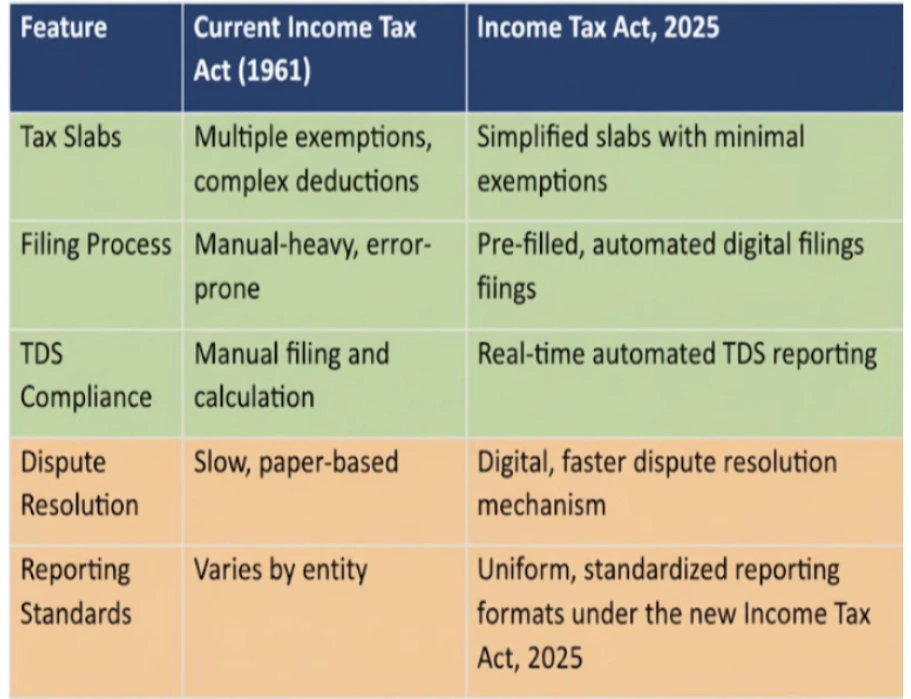
The Income Tax Act, 2025, cuts through red tape and brings much-needed clarity.
Compliance Prep Checklist: Stay Ahead of the Curve
Here’s your checklist to ensure full compliance with the Income Tax Act, 2025:
- For smooth pre-filled ITR forms, update your bank account information, PAN, and Aadhaar.
- Pay stubs, investment documentation, rent receipts, and business invoices should all be digitized and stored in well-organized digital folders.
- To comply with the Income Tax Act of 2025’s standardized reporting, use accounting software that has been approved by the government.
- Learn how to use the new ITR forms that the Income Tax Act of 2025 has created for automated filing.
- For ongoing updates on the Income Tax Act of 2025, sign up for official notifications from the Income Tax Department or trustworthy tax advising services.
Impact on ITR filing, TDS, and Deductions
The Income Tax Act, 2025, brings major improvements in ITR filing: most data come pre-filled for easier verification and submission.
Real-time TDS compliance under the new Income Tax Act, 2025, will eliminate delays and reduce errors.
The tax deduction structure is simplified, with only essential deductions, such as investments in retirement funds, and the remaining require thorough documentation.
Carefully reviewing pre-filled data is crucial under the new Income Tax Act, 2025, to avoid future notices.
Why Plan with Expert Tax Advisors Now
This is not just another tax update; it’s a paradigm shift. Waiting until the last moment risks penalties, filing errors, and missing out on essential deductions.
Expert tax advisors offer the most value by helping you:
- Install the appropriate accounting software that complies with the 2025 Income Tax Act.
- Make sure your credentials and digital KYC are current.
- Find valid ways to save money on taxes under the 2025 Income Tax Act.
- Remain completely compliant and audit-ready.
Getting expert assistance now is the best course of action rather than dealing with unforeseen issues later.
FAQ
1. What is the Income Tax Act, 2025?
It is the new simplified tax law replacing the Income Tax Act, 1961, focused on automation, transparency, and fewer exemptions.
2. When will the 2025 Act come into effect?
It will roll out in phases across 2025 for individuals, businesses, and HUFs.
3. Will old exemptions like HRA and LTA still be valid?
Under the new structure, many exemptions are removed. Only essential deductions remain, and they require strong documentation.
4. How will ITR filing change under the new law?
Forms will be pre-filled automatically using PAN–Aadhaar–bank integration. The taxpayer only needs to verify and approve.
5. What changes for businesses?
All TDS filings, audits, and returns become automated. Digital records are mandatory.
6. Do HUFs have new rules?
Yes. Income splitting and reporting face stricter checks to prevent misuse.
The Final Word
The Income Tax Act, 2025 marks a turning point in how India approaches taxation—bringing in a system that is simpler, more automated, and far more transparent than ever before. It is no longer just a legal framework; it is a shift toward smarter financial behavior and digital-first compliance. With new slab structures, revised deduction rules, and AI-driven verification, the responsibility now lies on every taxpayer to stay informed and stay prepared. Waiting for the deadline or depending on outdated methods will only lead to unnecessary stress, penalties, and missed opportunities.
Whether you’re a salaried individual trying to optimize deductions, a business navigating revised reporting norms, a freelancer dealing with quarterly tax obligations, or an HUF managing diversified income streams, the time to adapt is today—not tomorrow. Understanding these changes early gives you the advantage of planning better, avoiding errors, and maximizing your benefits under the new law.
Prepare for Income Tax Act 2025 Now!
Book a short advisory review to confirm your software, KYC & document readiness. Get prioritized support for business filings.