
Got an Income Tax Notice in 2025? Here’s How Indians Can Respond Without Penalty or Panic
The Truth About Tax Notices: They Are More Common Than You Think
In India, over 1.2 crore income tax notices are issued every year due to AIS mismatches, late filings, and high-value transactions. In 2025, with stricter AI-based monitoring by the Income Tax Department, even salaried employees and small freelancers are receiving notices unexpectedly.
If you’ve received an income tax notice in 2025, you’re not alone — but ignoring it can lead to penalties, interest, or reassessment. Let us break it down step by step.
If you’re unsure how to reply, professional Tax Notice Handling Services can help you respond correctly and on time.
Why You Received an Income Tax Notice in 2025 (Top Reasons for Indian Taxpayers)
The Income Tax Department does not send notices randomly. Each notice has a trigger, and once you understand the “why”, the “how to respond” becomes much simpler. Some common reasons include:
- Mismatch in AIS or Form 26AS (one of the top 3 causes of notices) – For example, your bank reported high FD interest, but you missed declaring it.
- Late or missed filing – Filing after the due date or skipping filing altogether can trigger a notice.
- High-value transactions above ₹10 lakh – Buying property, mutual funds, credit cards.
- Incorrect Income head selection (salary vs business income)
- Defective returns under Section 139(9) – Simple errors like incorrect PAN details or missed attachments.
- Re-assessment requests – Older cases may be reopened if discrepancies are found under Section 148A.
Knowing which bucket you fall into will immediately calm half your worries.
Types of Income Tax Notices in India
Not all notices are the same. Think of them as different “levels” of communication from the department. Here is a quick breakdown of the most common ones in 2025:
Section 143(1)
Intimation – A basic summary after you file your return. It shows whether you owe more tax or have a refund.
Section 139(9)
Defective Return Notice – Sent when your return has missing details or inconsistencies.
Section 148A
Re-assessment Notice – This comes if the department believes some income was missed in your past return.
Section 245
Adjustment of Refund – If you’re due a refund but have pending tax liabilities, this notice informs you about adjustments.
Section 142(1)
Inquiry Notice – The department may ask for documents, clarifications, or additional proof.
Each notice type has a different approach for handling, so identifying it correctly is necessary.
Approach to Handle the Tax Notice
1: Do Not Panic, Read Carefully
The first mistake most taxpayers make is assuming the worst. Instead, carefully check:
- The section number is mentioned
- The reason for notice (underlined in the letter)
- The response deadline
Once you know these three things, you will know whether it is a minor clarification or a serious follow-up.
2: Collect Your Papers Before You Respond
Think of this like preparing for an exam; you need the right documents. Depending on the notice, you may need:
- Salary slips, bank statements, and investment proofs.
- Form 16, Form 26AS, and Annual Information Statement (AIS).
- Purchase/Sale deeds if the issue is properly related.
- Business expense records for freelancers or corporates.
Organizing these in advance ensures your reply is crisp and error-free.
3: Reply Online; Yes, it is That Simple
The Income Tax portal in 2025 has made responding much easier. You can:
- Log into the Income Tax portal using your PAN and password.
- Go to the “e-Proceedings” or “Compliance” section.
- Select the notice reference number.
- Upload your reply and supporting documents.
- Submit with your Digital Signature Certificate (DSC) or Adhaar OTP.
The role of DSC (Digital Signature Certificate) is now more critical than ever, especially for corporates, LLPs, and professionals. Without it, your reply may not be considered valid.
4: Track, Do Not Forget
After replying, always track the status online. Notices do not disappear into thin air; you will get updates on whether the department has accepted your explanation or requires more documents.
What Happens if You Ignore a Tax Notice?
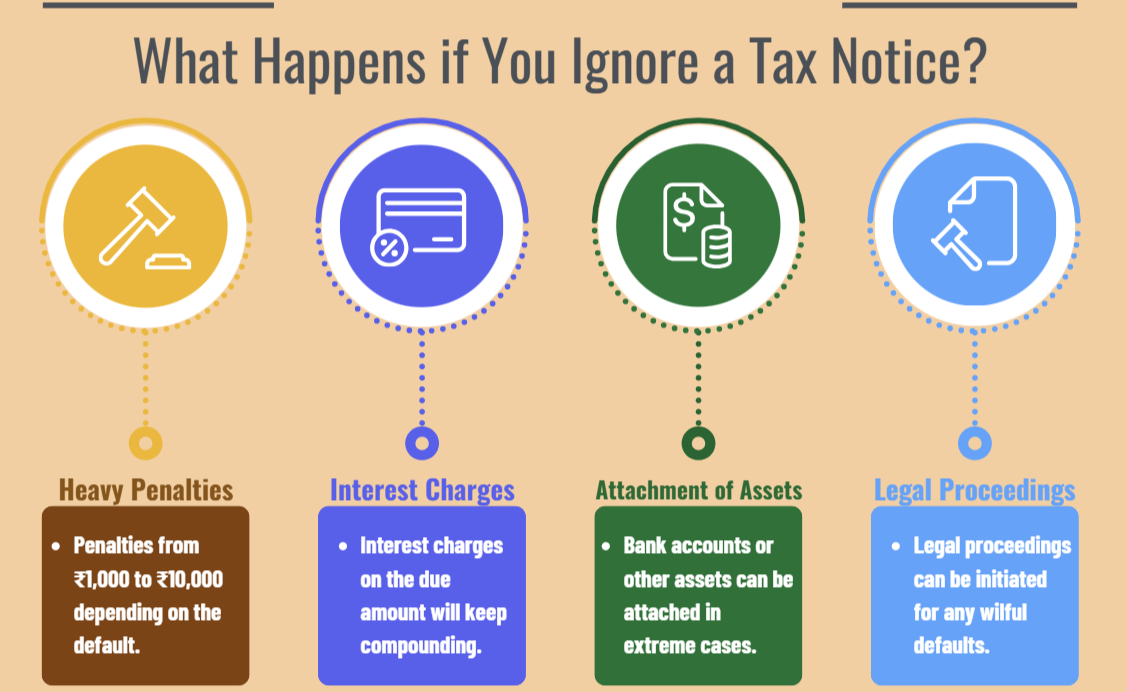
Here is the part that no one likes to read, but it is important. Ignoring a tax notice can lead to:
- Penalty up to ₹10,000 under Section 234F
- Interest under Sections 234A/B/C
- Adjustment or blocking of refunds
- Best judgment assessment
- Reassessment under Section 148
- Legal prosecution in extreme cases
Even a small mismatch can grow into a serious compliance issue
So even if you think it is “just a small error”, replying is always the smarter move.
Stay One Step Ahead, Not One Step Behind
For salaried employees, tax compliance is mostly handled at the payroll desk, but for freelancers, startups, and corporates, the game is different. One slip, one mismatch, and a notice could land in your inbox. The smart move is to get ahead of the system rather than chase after it later. Think of it as doing a little “financial housekeeping” every month.
It may sound dull, but in truth, it’s the shield that saves you from sleepless nights. More and more businesses are realizing that automation is not just a luxury; it’s a survival. Automated payroll and compliance tools can calculate, deduct, and file TDS or TCS without errors, leaving you free to focus on growth. And if something still slips through? A quick call to an expert will turn a potential storm into just a passing drizzle.
Got an Income Tax Notice? Get TaxuFiling Expert Help Before the Deadline
Responding to a tax notice is not about legal jargon; it is about staying calm and replying correctly. That is exactly where Taxufiling steps in as your safety net. Imagine getting a notice and instead of sweating over what “Section 143(1)” even means, you have a team that decodes it for you, drafts the reply, attaches the right proofs, and e-verifies it with your DSC in minutes. For a freelancer, it could be defending those expense claims. For a startup, it could mean handling a reassessment without shaking investor confidence. For a salaried employee, it might simply be fixing an income mismatch.
The point is, TaxuFiling doesn’t just close notices—it closes the loop of worry. What feels like a mountain suddenly looks like a small bump on the road. With experts on your side, you walk through compliance with confidence instead of fear.
FAQ
1. What’s the first thing I should do after receiving a tax notice?
Stay calm and read the section number, reason, and deadline. Understanding the notice correctly prevents mistakes. If you’re unsure, professional tax support services can help decode the notice and prepare a proper reply.
2. Do I always need a Digital Signature Certificate (DSC) to reply?
Not always – but for companies, LLPs, and professionals, a DSC is mandatory. If yours has expired or you need a new one, you can quickly obtain a valid DSC using the official eMudhra DSC service.
3. What documents do I need while responding to a tax notice?
You may need Form 16, AIS, bank statements, investment proofs, sale/purchase deeds, or business expense records. If you struggle with documentation, bookkeeping and tax support services can help you organize everything properly.
4. What if I ignore a tax notice?
Ignoring notices can lead to penalties, interest, refund hold, or even legal action in extreme cases. If you’re confused or unsure how to respond, legal consultation services can guide you correctly.
5. How can I avoid getting tax notices in the future?
Most notices arise due to mismatches in income reporting, TDS errors, or incorrect records. Using automated payroll management, correct bookkeeping, proper tax support, and timely filings can drastically reduce the chances of receiving notices again.
The Final Word: Stress Out, Strategy In
Here’s the truth: tax notices are not villains; they are just reminders. They are the system’s way of saying, “Let’s recheck the math together.” And when you stop treating them like monsters under the bed, you’ll see they are nothing more than a chance to stay compliant. Picture this: you open your inbox, spot a notice, and instead of panic, you take a sip of coffee, smile, and say, “Alright, let’s sort this out.” That is not fantasy; it is what preparation and professional guidance make possible.
Every notice you handle smartly is one more sign that you are in control. And with TaxuFiling as your partner, you will never face the system alone. Stress becomes strategy, panic becomes power, and every tax season becomes just another smooth chapter in your financial story. Whether you are a salaried employee, freelancer, startup, or business owner — TaxuFiling helps you respond accurately, legally, and stress-free.