Startup & MSME Compliance in FY 2025–26: Avoid Penalties & Stay Stress-Free
Starting or running a business in India is exciting, but let us be real, compliance can feel like a never-ending maze. Between GST filings, UDYAM registration, payroll rules, and endless certificates, many startups and MSMEs spend more time worrying about paperwork than building their business. However, the truth is that compliance is not just about avoiding penalties; it is about building credibility, trust, and long-term sustainability. Investors, customers, and even employees look at how disciplined a business is. In FY 2025-26, with new deadlines, tighter monitoring, and stricter digital tracking, staying compliant is no longer optional. Compliance mistakes can cost startups and MSMEs heavily in FY 2025–26.
So instead of dreading it, let us turn compliance into your business shield. This blog simplifies startup and MSME compliance for FY 2025–26, helping you stay legally compliant, investor-ready, and stress-free.
Mandatory Registrations for Startups & MSMEs in India (FY 2025–26)
Every startup or MSME must begin with the right registrations. Think of these as your business passport; without them, you are invisible in the eyes of the law (and investors).
GST Registration: The Tax Backbone
- Mandatory if your turnover exceeds Rs 40 lakhs (Rs 20 lakhs for services in some states).
- Without GST, you cannot claim Input Tax Credit (ITC) or work with large corporates who demand GST invoices.
- In FY 2025–26, GST compliance is under AI-driven scrutiny:
- Automated invoice matching
- Real-time ITC reconciliation
- Faster notice issuance for mismatches
As per GST Council data, over 1.2 crore GST notices were issued in FY 2024–25 due to filing errors.
UDYAM Registration: The MSME Badge
UDYAM registration is essential for MSMEs in India to:
- UDYAM gives you recognition as a micro, small, or medium enterprise.
- Get access to lower-interest MSME loans.
- Claim government subsidies.
- Get protection under MSME delayed payment laws
- Improve credibility with banks and investors
It is free, online, and directly linked with PAN and Adhaar; no excuses to skip it. Startups who want a smooth UDYAM and business setup experience can also explore assistance with business registrations.
EPFO and ESI: For Employee Security
- If you have 20 plus employees, EPFO (Provident Fund) registration is mandatory.
- For 10 plus employees, ESI registration ensures health coverage.
- Beyond compliance, these schemes show employees you care about their future; a big win for startups competing for talent.
Professional Tax: The State-Level Must
- Levied by state governments on salaried employees, professionals, and employers.
- Not all states impose it, but wherever applicable, skipping Professional Tax can invite penalties.
Trade License: Local Approval to Operate
- Issued by municipal bodies, the trade license gives you the right to run your business at a given location.
- Especially important for food, retail, and service businesses.
Pro tip: keep a master file of registrations with renewal dates clearly marked. A simple Google calendar reminder can save you lakhs in penalties.
Startup India Registration: Unlocking Hidden Benefits
The government’s Startup India Initiative continues to be a golden ticket for new-age businesses in 2025. Registering on the portal brings a basket of advantages. TaxuFiling.com simplifies the process and reduces errors.
- Tax holidays, like eligible startups get income tax exemptions for three consecutive years.
- Recognition improves your credibility with banks, NBFCs, and even angel investors.
If you want expert help with startup recognition and documentation accuracy, the business licensing is extremely helpful. - Faster exit process, easier compliance, and self-certification under labour and environmental laws.
If you are a genuine startup but have not registered yet, you are leaving money and credibility on the table.
Amnesty and Extensions: The Smart Founder’s Advantage.
The government occasionally provides extensions and amnesty schemes for compliance deadlines. Many tools can help track deadlines and amnesty schemes effectively. Many startups sigh with relief when deadlines are extended, but this is where strategic thinking matters. Treating these opportunities as mere reprieves is a missed chance. Amnesty schemes allow businesses to clear past defaults with reduced penalties and interest. FY 2025-26 sees tighter tracking by tax authorities, making proactive use of these windows essential. Businesses that leverage extensions wisely not only avoid fines but also reset their compliance health, giving them a cleaner track record for investors and banks. Delaying action, even with extended deadlines, often leads to compounded penalties and unnecessary stress.
Common Compliance Risks for Startups in FY 2025–26
- Missed GST or TDS deadlines
- Incorrect employee PF/ESI calculations
- Non-renewal of trade licenses
- Ignoring professional tax obligations
- Poor bookkeeping and documentation
Building a Compliance Calendar: Your 12-Month Roadmap
Chaos and compliance are a bad mix. A compliance calendar transforms scattered obligations into a structured, predictable rhythm. For startups and MSMEs, knowing exactly what to file, pay, and report each month prevents last-minute panic.
12-Month Startup Compliance Calendar
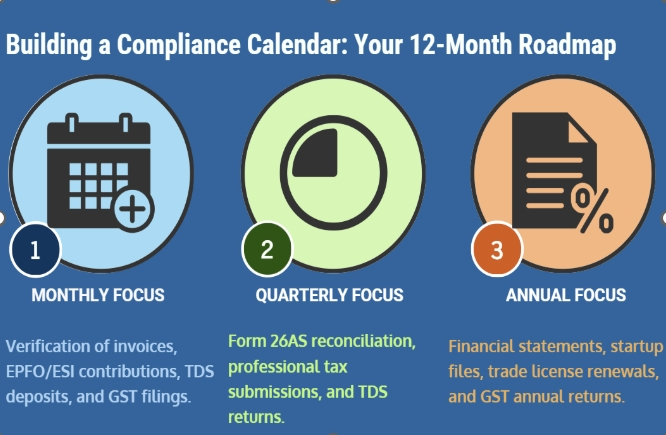
Digitizing this calendar, linking it to reminders, and assigning one compliance champion ensures deadlines are not missed. The businesses that thrive are those that treat compliance like a rhythm, not a chore; turning regulatory deadlines into predictable steps toward growth.
Practical Compliance: Real-Life Examples
Consider a Delhi-based food startup. Initially, they struggled with EPFO and ESI deposits, GST reconciliation, and TDS filings. Missed deadlines caused penalties, and investor confidence waned.
After automating compliance:
- Penalties reduced to ₹0 in 12 months
- GST reconciliation errors dropped by 90%
- Investor confidence improved significantly
A retail MSME in Pune is the subject of another case. They failed to pay professional taxes and renew their trade licenses on time. The company met deadlines in FY 2025–2026 by incorporating automation systems and employing a dedicated compliance officer. The outcome? improved employee satisfaction, less stress, and a better standing with suppliers. This digital signature service simplifies filings and verifications seamlessly
These examples highlight a simple truth: proactive compliance converts risk into opportunity.
The Human Side of Compliance: Making It Engage, Not Painful
Let us be honest: compliance can feel boring. But it does not have to be. By humanizing processes:
- Automating routine tasks reduces stress.
- Visual dashboards make tracking progress intuitive
- Clear calendars and reminders turn deadlines into milestones.
Startups that embrace this mindset find compliance less like a hurdle and more like a business enabler. When your team sees filing returns or processing payroll as part of building a professional, credible business, compliance becomes motivating rather than tedious.
FAQ
1. What are the most important compliances for startups and MSMEs in FY 2025-26?
The top compliances include GST registration and timely filing, UDYAM registration, EPFO/ESI (if applicable), TDS payments, professional tax, trade license renewals, and maintaining accurate books of accounts. In 2025-26, AI-based tax tracking makes timely filings more important than ever.
2. Do all startups need GST registration in 2025?
No. GST registration is mandatory only if your turnover crosses ₹40 lakhs (or ₹20 lakhs for services in some states). However, many startups voluntarily register because clients and corporates demand GST invoices, and Input Tax Credit (ITC) benefits reduce tax burden.
3. Why is UDYAM registration important for MSMEs?
UDYAM registration unlocks government schemes like cheaper loans, subsidies, faster tender approvals, and protection against delayed payments. It also gives your business official MSME recognition, which improves credibility with banks and investors.
4. What happens if a startup misses GST or TDS deadlines?
Missed deadlines lead to interest, penalties, and notices. In 2025, stricter AI-based matching means repeated delays can even freeze your ITC or trigger audits. A compliance calendar or automated system helps prevent these issues.
5. Is EPFO/ESI mandatory for small startups?
EPFO becomes mandatory if you have 20+ employees.
ESI becomes mandatory if you have 10+ employees.
Even if you’re smaller, opting in voluntarily helps you appear more professional and employee friendly.
6. What is the benefit of automating compliance in 2025?
Automation eliminates human error, ensures timely filings, reduces penalties, and gives you a dashboard to track deadlines. Startups that automate compliance often save costs, improve investor trust, and operate more smoothly.
7. Do startups get tax benefits under Startup India in 2025?
Yes. Eligible startups can still apply for income-tax exemptions for 3 consecutive years. They can also self-certify under labour and environmental laws and receive faster processing for registrations and exits.
8. Can startups outsource compliance in India?
Yes. Many startups outsource GST, payroll, and compliance management to professional platforms like TaxuFiling, reducing errors and saving time.
Final Word: Turning Compliance into Your Startup Superpower
FY 2025-26 is challenging, but the right compliance strategy can transform it into a growth accelerator. From GST to UDYAM, EPFO to Startup India benefits, every filing and registration strengthens your business’s credibility. Treat compliance as a shield, a growth tool, and a signal to investors, employees, and partners that your startup pr MSME is serious, disciplined, and ready for scale. Platforms like TaxuFiling.com can make the entire compliance journey easier and more reliable.
The startups and MSMEs that will dominate in 2025-26 won’t just be innovative; they will be compliant, credible, and trusted. And that is the real superpower. Embrace it, automate it, and watch your business thrive.
Take Action Now with TaxuFiling To:
- Avoid penalties in FY 2025–26
- Stay compliant with Indian tax laws
- Focus on growth, not paperwork