
Latest GST Updates: What Changed, What Is Tripping Businesses Up, & What You Need to Do
Nobody who started a business in India thought GST would eventually become this involved. The original idea was straightforward enough. Replace the old, complicated tax structure with something cleaner and more unified. And for a while, even with all the early confusion, that direction made sense.
But 2026 looks very different from those early days.
GST Is Now Watching Everything Your Business Does
GST today is not something you file once a month and forget about.
It has grown into a system that is actively connected to how your entire business operates. The invoices you raise, the money moving through your bank account, what you declared in your income tax return, even your business registration status, all of it is being looked at together. When something does not match up across these sources, the system does not wait. It flags it immediately.
For a lot of business owners this has been genuinely surprising. Businesses that were running fine for years started receiving notices they did not expect. Credits got blocked without warning. Cash flow got tighter in ways that were hard to trace back to a single cause. And by the time most people figured out what was happening the problem had already grown bigger.
Understanding what GST actually looks like in 2026 is no longer background knowledge. It is something every business owner in India needs to have a clear picture of.
What Is Actually Different Now
The change that matters most in 2026 is not a new rate or a new form to fill out. It is the way the entire system has been wired together behind the scenes.
GST is now pulling data from income tax records, company registration information, customs data, and banking transactions all at once. Each invoice is checked. Your credit claims are looked at closely. And your returns get matched with data coming in from different places. The old situation where things could sit in a grey area for a while and get sorted out later simply does not exist anymore.
Here is what businesses are actually running into right now:
- GSTR 1, GSTR 3B, and GSTR 2B are being matched against each other more strictly than ever before
- Notices are going out automatically the moment the system spots a mismatch, no human review needed
- Nil returns are getting flagged when transaction data from other sources shows the business was clearly active during that period
- Input tax credit is being blocked faster than before when vendors fall behind on their own filings
The shift is worth understanding clearly. Businesses are no longer just reporting what happened. They are reconciling their own records against a version of events the government has already built from other sources. That requires a genuinely different level of attention than most businesses were used to giving GST.
You Can Do Everything Right & Still Lose Input Tax Credit (ITC) Today
For most businesses input tax credit is central to how GST affects the bottom line. It is also where the most damage is happening in 2026.
There was a time when businesses could claim ITC and deal with any issues that came up afterwards. That window is closed now. The rules are applied upfront and corrections after the fact are much harder to make.
The way it works today is straightforward but strict:
- ITC can only be claimed when it appears correctly in GSTR 2B, no exceptions
- If a vendor files late or not at all, your credit gets blocked even if your own paperwork is perfect
- Reversals and reclaiming rules are being enforced strictly with very little room for error
- Working capital gets squeezed fast when multiple vendors are non-compliant at the same time
This is genuinely frustrating for business owners who are doing everything right on their side. But that is the reality of how the system works now. Your compliance alone is not enough. You are also affected by the compliance of everyone you buy from.
What You Can Do Now to Stay in Control
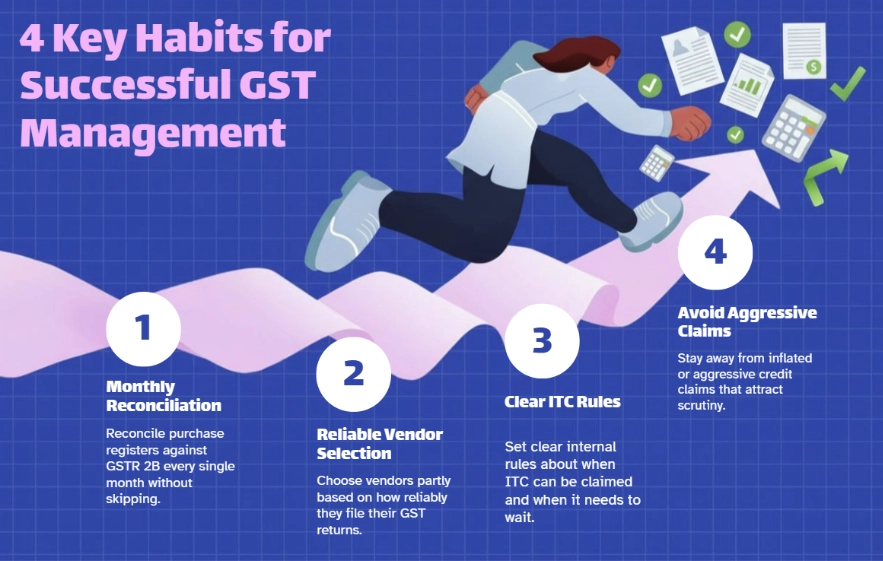
You can’t change how the system works, but you can change how you handle it. A few simple habits can make a big difference and help you avoid most of these problems.
GST Notices Are Faster and More Common Than People Expect
A few years ago, getting a GST notice felt like a serious and rare event. In 2026 notices are routine, automated, and go out quickly when the system spots something it does not like.
The most common triggers right now are:
- Differences between what was reported in GSTR 1 versus GSTR 3B
- ITC claims that are higher than what GSTR 2B shows
- Nil returns filed when the system can see from other data that transactions were happening
- Gaps between GST turnover figures and what was declared in the income tax return
Most of these notices are not accusations. They are the system asking a question and wanting an explanation. Most of them can be resolved completely online without things escalating, if they are handled promptly with the right documents in hand.
Where businesses get into real trouble is when they ignore notices or leave them sitting past the deadline. Here is what that can lead to:
- Financial penalties added on top of whatever the original issue was
- Interest that keeps building the longer the response is delayed
- The case moving into full scrutiny assessment by the department
- Refunds that were expected getting adjusted against outstanding demands instead
- Future returns getting looked at much more closely every single time
Responding early almost always keeps things manageable. Waiting turns small issues into expensive ones.
E-Invoicing and E-Waybills Now Apply to More
E-waybill requirements have also gotten stricter, particularly for:
- Goods moving between states
- High value shipments
- Transport patterns that the system flags as unusual or repetitive
For businesses that are not set up properly for this the consequences can include penalties, vehicles being stopped and detained during transit, and in serious cases cancellation of GST registration altogether.
What Needs to be in Place
- Invoices generated accurately with every required detail included
- Reporting happening in real time rather than in batches after the fact
- Accounting software properly integrated with GST systems so there is no manual gap
Manual invoicing processes create exactly the kind of gaps where errors get introduced. In 2026 those errors are being caught and acted on quickly.
How GST Problems Quietly Drain Cash Flow
This is something that does not get talked about enough. A lot of businesses run into serious cash flow problems not because they are unprofitable but because GST issues have been quietly building up in the background.
The ways GST affects cash flow right now include:
- Blocked ITC tying up money that should be available and working in the business
- Refunds arriving more slowly when data mismatches exist in the system
- Interest on late payments adding up gradually and consistently over time
- Working capital getting squeezed when vendor non-compliance blocks credits that were being counted on
None of these are dramatic single events. They accumulate quietly and then suddenly the business is dealing with a cash flow situation that feels like it came from nowhere. Treating GST management as a financial priority, not just a compliance task, is genuinely one of the more important decisions a business owner can make in 2026.
What Staying Compliant Actually Looks Like Day to Day
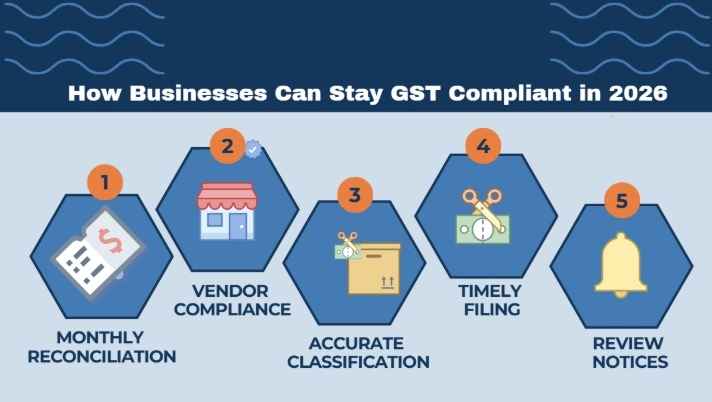
Businesses that handle GST well in 2026 are not doing anything extraordinary. They have just built consistent habits around it. Here is what that looks like in practice:
Monthly reconciliation of GSTR 1, GSTR 3B, and GSTR 2B done without exception every single month
Vendor compliance being tracked regularly so problems are caught before they affect ITC
Goods and services being classified correctly because wrong classification is a more common notice trigger than most people realise
Returns filed on time every month without last minute rushes that lead to errors
The GST portal is being checked regularly for notices and alerts, so nothing sits unresponded to.
Outsourcing GST compliance to experts like TaxuFiling helps businesses avoid errors, penalties, and unnecessary stress.
Why Professional Support Is Worth It in 2026
Professional GST support means:
Rules being interpreted correctly so nothing falls through the gap between intention and execution
Reconciliations and filings are handled accurately by people who do this every single day
Notices responded to properly and on time before they escalate into bigger problems
Strategic advice on optimising ITC within the rules rather than guessing and hoping
Business owners being able to focus on running their business instead of worrying about compliance
In 2026 getting GST wrong is expensive. Having expert help is not a luxury. It is just the smarter way to operate.
FAQ
Yes significantly. Real-time data matching and automated notices mean there is much less room for error than there used to be even two or three years ago.
If it is not in GSTR 2B it cannot be claimed. This is enforced strictly and there is no workaround.
Usually because of mismatches between different returns or because a vendor has not filed properly. Your own clean record is not always enough on its own.
It applies to more businesses than before because the threshold has come down. Worth checking whether your current turnover brings you under the requirement.
Repeated non-compliance or ignored notices can lead to suspension and recovering from that takes real time and money.
Final Thoughts
GST in 2026 is not just a tax obligation. It reflects how transparently and carefully a business is being run. Businesses that take it seriously operate more smoothly, manage cash flow more predictably, and build stronger credibility with vendors and stakeholders over time. Businesses that treat it casually end up with notices, blocked credits, and compounding problems that cost significantly more to fix than they would have cost to prevent.
The approach that works is straightforward. Stay proactive, stay accurate, and have the right people supporting you. With expert partners like TaxuFiling handling the compliance side, GST stops being something that keeps business owners up at night and starts being genuinely under control.
If you want to get your GST sorted properly and stop worrying about notices and blocked credits, TaxuFiling is the place to start. Let the experts handle your GST compliance so your business can focus on growing.